-
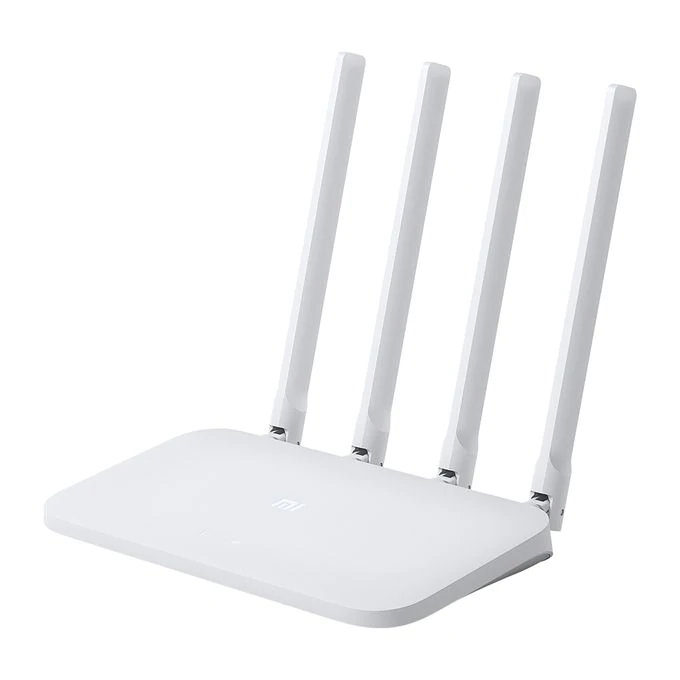
The Xiaomi Mi Router 4C is a budget-friendly, single-band wireless router from Xiaomi, launched in 2020 as an entry-level option for small homes, apartments, or offices. It’s designed for basic internet needs like streaming, browsing, and connecting smart home devices, with a focus on affordability and easy app-based management via the Mi WiFi app. While it’s now an older model in 2025 (superseded by newer AX-series routers like the Mi Router AX1800), it remains popular in emerging markets for its value, supporting up to 64 devices with stable 2.4GHz coverage. The white variant features a minimalist geometric design that blends into any space.
Key Features
- Wireless Specs: Single-band 2.4GHz Wi-Fi (802.11b/g/n) with 2×2 MIMO technology for speeds up to 300Mbps; 4 external omnidirectional high-gain antennas for coverage up to 10m diameter (ideal for 1-2 bedroom homes).
- Wired Connectivity: 2x 100Mbps LAN ports and 1x 100Mbps WAN port for basic Ethernet setups; no Gigabit support, limiting wired speeds to 100Mbps.
- Performance and Management: 64MB DDR2 RAM and 16MB ROM for handling multiple connections; intelligent speed limiting, unauthorized access alerts, and URL filtering for parental controls; app-based setup and optimization for gaming/video.
- Power and Design: Low 5W consumption; compact dimensions (200 x 141 x 28.2 mm, ~240g) with matte white plastic body and recessed power button.
- Extras: Supports up to 64 devices (lab-tested; recommend ≤32 for best performance); no dual-band or advanced security like WPA3.
Performance and User Feedback
The Mi Router 4C handles everyday tasks reliably, with users reporting stable signals for HD streaming and light multi-device use in small spaces—coverage holds up to 100-150 sq ft without major drops. The Mi WiFi app simplifies setup (under 5 minutes) and monitoring, with features like guest networks and device prioritization earning praise for beginners. However, as a single-band model, it struggles with interference in crowded 2.4GHz environments (e.g., apartments), and speeds cap at ~100-150Mbps real-world Wi-Fi. Wired connections are limited to 100Mbps, frustrating fiber users expecting 200-300Mbps. Reviews are mixed: Versus.com gives it a solid 7/10 for basics, but Quora and Reddit users warn of frequent outages, lags, and recommend TP-Link or D-Link alternatives for reliability. Overall, it’s “great for the price” (4.3/5 on Amazon India) if you’re on basic broadband, but upgrade for modern needs.
Call us on +254724495659 or +254708744335 to place your order.
Call us on +254724495659 or +254708744335 to place your order.

Hotline Order:

Email ID:
sales@scartek.co.ke
Xiaomi Mi Router 4C
Original price was: KSh3,499.KSh2,999Current price is: KSh2,999.
- Key Features
- Four high gain antennas for strong signal and quick transmission.
- Brief appearance for various home style integration.
- Smart management function for remote control.
- Intelligent network watching function for ensuring network security.
- Intelligent speed limit function for faster performance.
- 64MB capacity for up to 64 smart devices accession.